
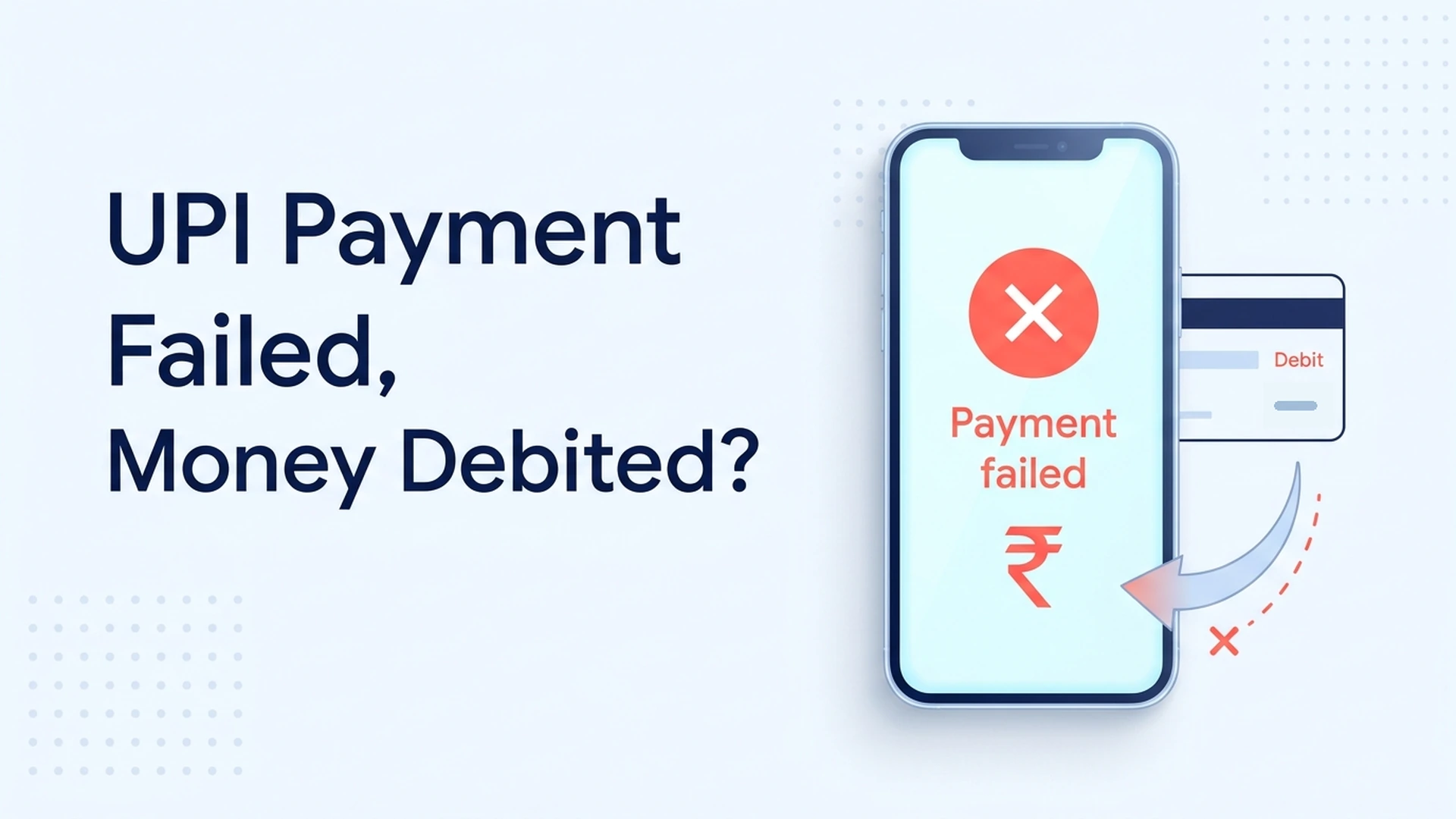
You tap pay, the screen spins, and then it says “failed.” But the SMS from your bank a second later says money left your account. Your first instinct is to send the payment again. Do not do that yet. In the vast majority of cases, that money comes back on its own, and sending it a second time is how people end up paying twice for one chai or one electricity bill.
The short answer: a UPI payment failed but money debited is treated as a failed transaction under RBI rules, not a successful one. Your bank is required to reverse it automatically, and you are entitled to compensation if they are late. Here is exactly how long that takes, what you need to do, and where it usually gets stuck.
What actually happens when a UPI payment fails
UPI is a “credit push” system. When you enter your PIN, your bank debits your account first, then sends the instruction to the beneficiary bank. If something breaks in that chain, your money is sitting in a suspense or pool account, not in the recipient’s hands. It has not disappeared.
The failure usually happens at one of three points. Your bank’s server times out before sending the instruction. The recipient bank is down and cannot accept the credit. Or the merchant’s system does not send back a confirmation, so the whole transaction is marked as “deemed approved” but unconfirmed. In every one of these cases, the system is designed to send the money back to you without you asking.
The Reserve Bank of India’s Harmonisation of Turn Around Time circular, issued in September 2019 and still in force, sets the outer limits for that reversal. The National Payments Corporation of India circulates the same timelines to all banks and payment apps [citation:16].
How long a refund should take, the two timelines:
There is a difference between sending money to a person and paying a merchant. The RBI rulebook treats them separately, and the wait is longer for merchant payments.
| Transaction type | Reversal deadline | Compensation if late |
|---|---|---|
| UPI transfer to a person (P2P) | Next working day (T+1) | Rs 100 per day of delay |
| UPI payment to a merchant (P2M) | Five working days (T+5) | Rs 100 per day of delay |
The “T” here is the date of the transaction, not the date you notice the problem. If you paid a friend on Monday and the money does not reach them, your bank has until Tuesday to put it back. If you paid a shop on Monday and the confirmation fails, the deadline stretches to the following Monday [citation:1][citation:6].
That Rs 100 per day compensation is not something you have to beg for. The NPCI circular says it must be credited “suo motu,” meaning on the bank’s own initiative [citation:16]. In practice, it rarely shows up unless you ask. A small cooperative bank in Gujarat was penalised by the RBI in 2025 specifically for failing to pay this compensation on failed UPI and IMPS transactions [citation:9].
What to do in the first hour
Wait. Do not retry the payment. Do not close the app or delete the SMS. Most failed UPI transactions reverse within minutes, and a large chunk of them within the hour [citation:12]. Set a timer for 60 minutes and do something else.
The transaction status screen is your best friend here. Open your UPI app, go to history, and tap the failed transaction. If it says “pending” or “processing,” the system is still trying. If it says “failed” with a UTR number, the reversal is already in motion. The UTR is a 12-digit reference number that every bank and NPCI uses to locate that exact transaction. Screenshot it before anything else [citation:5].
How to raise a complaint inside the UPI app
If the money has not returned by the next working day for a person-to-person transfer, or five days for a merchant payment, stop waiting and raise a dispute. Every UPI app has a built-in complaint option, and it is faster than calling customer care.
- Open the transaction in your UPI app’s history.
- Look for “Need help,” “Report issue,” or a question mark icon.
- Select the issue type. For a failed payment, choose “Payment failed but amount debited” or similar wording.
- Upload the screenshot of the transaction and your bank SMS.
- Submit. You will get a complaint reference number on the screen and usually by SMS.
This complaint goes to your Payment Service Provider, which is the bank behind the app, not the app company itself. The app is just the front end. The bank is the regulated entity that owes you the refund [citation:10].
Save that reference number. Every subsequent escalation will ask for it.
When the UPI app does not help: the bank and NPCI route
If the in-app complaint gets no response, or you get a reply that does not make sense, call your bank’s customer care. Quote the UTR and the UPI complaint reference number. Ask them to raise a UPI dispute. The person on the phone may not know what you are talking about, so be patient and ask for a written complaint number.
You can also email your bank’s grievance redressal address, which is listed on the bank’s website under “customer care” or “grievance.” Keep the email short: transaction date, amount, UTR, what went wrong, and what you want. Attach the screenshots. This creates a paper trail that the RBI Ombudsman will ask for later [citation:3].
NPCI itself does not accept complaints directly from customers, but your bank is required to escalate unresolved disputes to NPCI through the banking channel.
Filing with the RBI Ombudsman
This is the step most people never reach, and it is the one that actually forces action. The RBI’s Complaint Management System at cms.rbi.org.in accepts complaints against banks, payment system participants, and other regulated entities [citation:13].
Before you file, you must have complained to the bank first and waited 30 days. If the bank responds within 30 days with something unsatisfactory, you can go to the Ombudsman immediately after that response. You have 90 days from the bank’s reply, or 90 days after the 30-day window expires, to file [citation:8].
The process is free and online. You select the bank, enter your details, describe the problem, and upload the bank’s response or evidence that 30 days have passed. The system gives you a complaint reference number, usually by SMS and email. The RBI forwards the case to the bank. If the bank’s reply does not satisfy you, the Ombudsman takes it up. Most cases close within about a month [citation:8][citation:17].
If the Ombudsman rules in your favour, the bank must comply once you accept the award in writing within 30 days. If you are not satisfied with the Ombudsman’s order, you can appeal to the Appellate Authority within the RBI within 30 days [citation:8].
What not to do while you wait
The single biggest mistake is paying again. If you send a second payment while the first is still pending, you now have two disputes and a merchant who may receive double. The reversal on the first payment will still happen, but you have made your own life harder.
Do not delete the transaction SMS. Do not clear your UPI app’s history or cache. Do not close the bank account. And do not fall for anyone on social media or WhatsApp who says they can “process your refund for a small fee.” Banks, NPCI, and the RBI never charge you to reverse a failed transaction [citation:5].
One more thing: a failed transaction is not the same as sending money to the wrong person. If you typed a wrong UPI ID and the money actually reached someone, that is a successful transfer. The automatic reversal rules do not apply. You need to contact your bank and file a complaint, but recovery depends on the recipient agreeing to return it. That is a slower, more uncertain process [citation:6].
Frequently asked questions
How long does a UPI refund take for a failed transaction?
For a transfer to another person, the money should come back by the next working day. For a merchant payment, it can take up to five working days. In practice, most refunds land within a few hours [citation:1][citation:15].
What is the Rs 100 compensation for delayed UPI refunds?
If the bank misses the T+1 or T+5 deadline, it owes you Rs 100 for every day of delay beyond that deadline. This comes from the RBI’s 2019 circular on turnaround time and customer compensation [citation:7].
Can I complain to NPCI directly about a failed UPI transaction?
No. NPCI works through banks and payment service providers. You raise the complaint with your bank or UPI app, and the bank escalates to NPCI if needed. The RBI Ombudsman is the final escalation point for you as a customer [citation:3].
What if the UPI app shows success but the recipient did not get the money?
That is a “deemed approved” transaction. The money is in transit, not with the recipient. It should reverse automatically. If it does not, treat it as a failed transaction and raise a complaint with the UTR [citation:16].
Do I need a lawyer to file with the RBI Ombudsman?
No. The process is free and designed for ordinary customers. You file online, upload documents, and track the complaint with the reference number the system gives you [citation:17].
The honest bottom line
Your money is not lost. It is held in the banking system while the failed transaction is reconciled. The system is built to return it automatically, and the RBI has set deadlines and compensation for when banks drag their feet.
But the system only works if you do two things: wait before retrying, and keep the UTR and complaint numbers safe. Most people who never get their refund simply never escalated past a phone call to customer care. cms.rbi.org.in exists for exactly this situation, and it costs nothing to use.
One caution: if the payment went to the wrong person and was successful, the automatic reversal rules do not help you. That is a recovery request, not a failed transaction, and the bank can only ask the recipient to return the money, not force them.
Related post: Icici loan application status
Facts checked: 13 October 2026

She is a professional and experienced senior article writer and editor. She is working in Indian Government Schemes, Education, and Media Communication. She has completed her MJMC, and now working at StatusChecker.in as a Senior Editor and writer. She has more than ten years of experience in Media communication, and article writing. So we hope you will enjoy her article. If you have any complaints or suggestions for her. You can contact us through our Contact Us page.